

Have you ever wondered why you impulsively bought that “limited edition” gadget, or why you felt compelled to donate to a charity after signing a simple petition? It wasn’t magic—it was psychology.
Decades ago, Dr. Robert Cialdini wrote the seminal book Influence: The Psychology of Persuasion. He identified six universal principles that guide human behavior and drive us toward saying “Yes.”
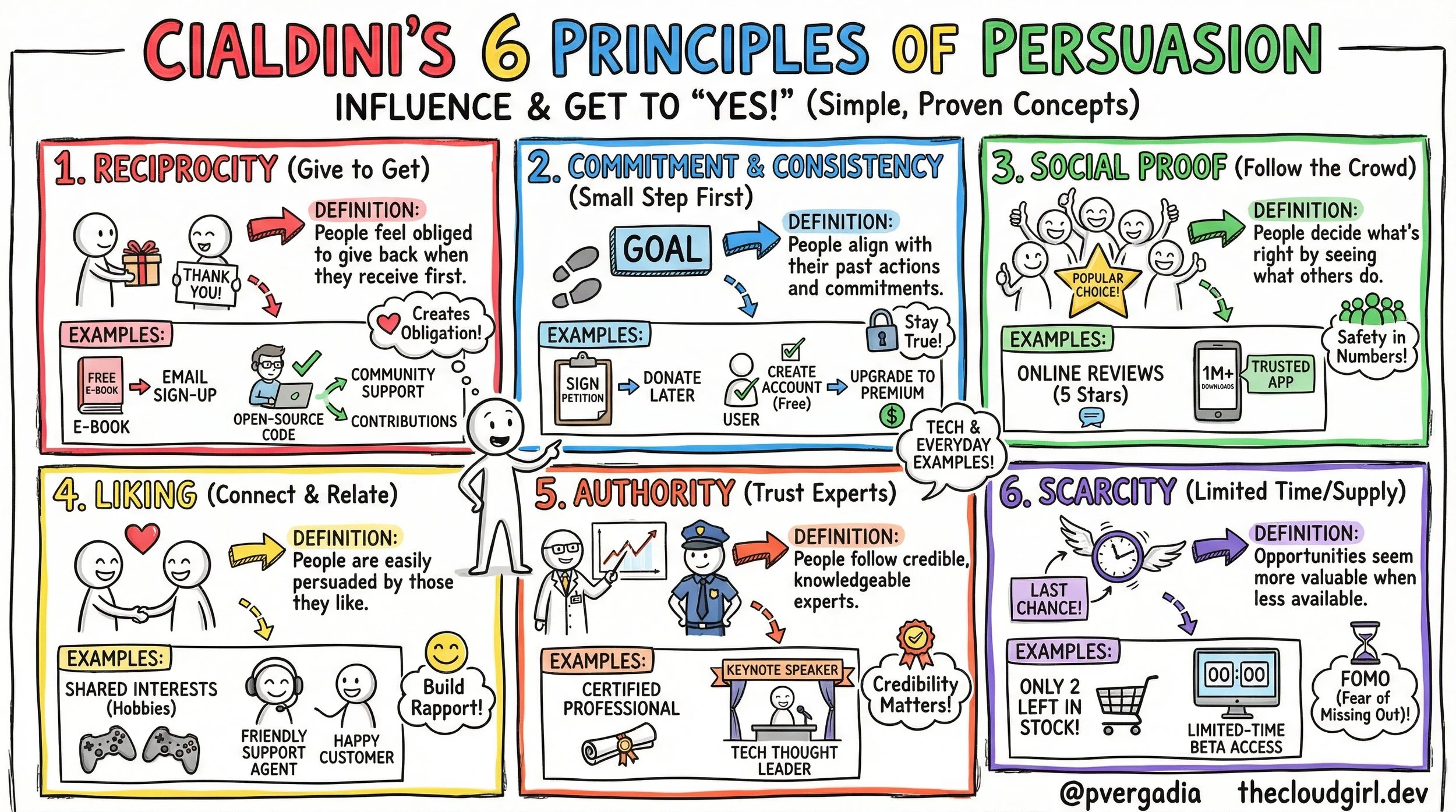
Whether you are a marketer, a developer building a user base, or just someone trying to convince your team to adopt a new tool, understanding these principles is a superpower. Let’s break down these six concepts using the visual guide above.

1. Reciprocity (Give to Get)
The Core Concept: Human beings are wired to hate owing debts. If you do something nice for someone, they feel a biological and social obligation to return the favor.
-
How it works: It creates a sense of obligation. You give value first without immediately asking for a return.
-
Real-World Examples:
-
Marketing: Offering a free E-Book or whitepaper in exchange for an email sign-up.
-
Tech Community: When developers contribute to open-source code, the community often feels compelled to support that developer’s paid projects or offer help in return.
-
2. Commitment & Consistency (Start Small)
The Core Concept: We all want to look consistent. Once we make a choice or take a stand, we encounter personal and interpersonal pressure to behave consistently with that commitment.
-
How it works: Start with a small ask (a micro-commitment). Once a user says “yes” to the small thing, they are much more likely to say “yes” to a bigger thing to stay aligned with their self-image.
-
Real-World Examples:
-
Activism: Getting someone to sign a petition (easy) often leads to them donating money later (harder).
-
SaaS Growth: Getting a user to create a free account makes them mentally “commit” to your platform, making an upgrade to Premium much more likely than a cold sale.
-
3. Social Proof (Follow the Crowd)
The Core Concept: When we are uncertain, we look to others to determine correct behavior. We assume that if many people are doing something, it must be the right thing to do.
-
How it works: It leverages “safety in numbers.”
-
Real-World Examples:
-
E-Commerce: Seeing 5-star reviews or testimonials reduces purchase anxiety.
-
App Stores: A badge stating “1M+ Downloads” or “Editor’s Choice” signals to a new user that the app is trustworthy and popular.
-
4. Liking (Connect & Relate)
The Core Concept: It sounds obvious, but it is powerful: We prefer to say yes to requests from people we know and like.
-
How it works: We like people who are similar to us, who pay us compliments, and who cooperate with us towards mutual goals. This builds rapport.
-
Real-World Examples:
-
Sales: Finding shared interests (like gaming or sports) creates an immediate bond.
-
Customer Success: A friendly support agent who uses a human tone can turn an angry user into a happy, loyal customer simply through the power of relatability.
-
5. Authority (Trust Experts)
The Core Concept: We are trained from birth to follow the lead of credible, knowledgeable experts. We trust titles, uniforms, and certifications.
-
How it works: Authority signals (like a “Dr.” title or a “Verified” badge) act as a shortcut for decision-making.
-
Real-World Examples:
-
Professional Services: Displaying badges like “Certified Professional” or awards.
-
Thought Leadership: We listen to the Keynote Speaker at a tech conference because the stage itself confers authority.
-
6. Scarcity (Limited Time/Supply)
The Core Concept: The Fear of Missing Out (FOMO). Opportunities seem more valuable to us when their availability is limited.
-
How it works: We hate losing freedoms. When our ability to choose a specific item is threatened by limited stock or time, we desire it more.
-
Real-World Examples:
-
Retail: The classic “Only 2 left in stock!” notification.
-
Product Launches: Offering “Limited-time Beta Access” makes getting into the software feel like an exclusive privilege rather than a standard sign-up.
-
A Note on Ethics
While these principles are incredibly effective, they should always be used with integrity. The goal isn’t to manipulate people into doing things they don’t want to do; it is to lower the friction for them to do things that are actually good for them (like buying your excellent product or reading your helpful content).
Start noticing these principles in your daily life—once you see them, you can’t unsee them!