Supervised vs Unsupervised vs Reinforcement Learning
Ever felt like training an AI is a bit like teaching a puppy? Sometimes you give it explicit commands, sometimes you just let it figure things out, and other times it learns by getting a treat (or a scolding!). That, my friends, is essentially the heart of Supervised, Unsupervised, and Reinforcement Learning in a nutshell.
Teaching Our Robotic Pal, Rusty
Imagine you're trying to teach a new robotic assistant, Rusty, how to sort mail.
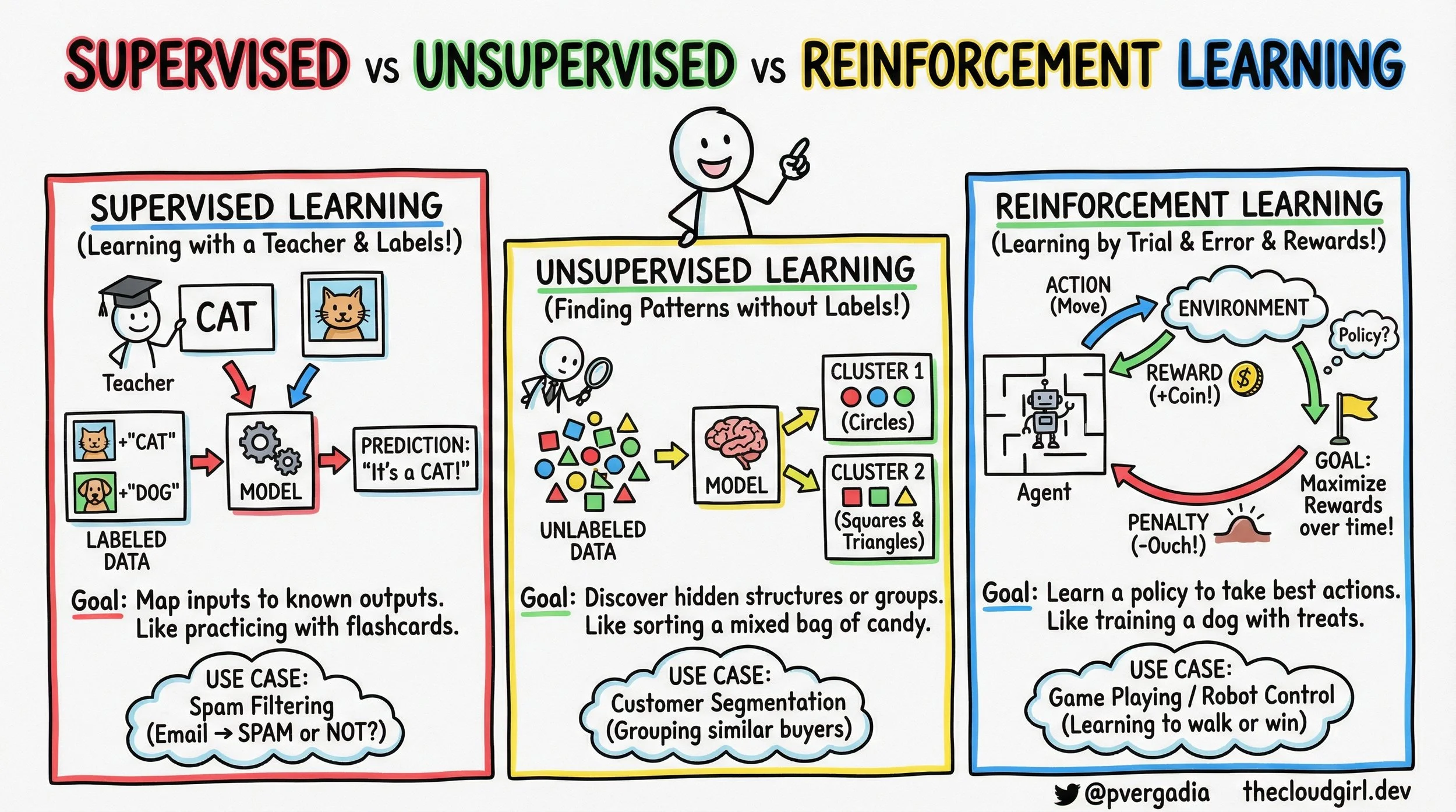
Supervised Learning: You show Rusty thousands of envelopes, each *pre-labeled* as 'Urgent', 'Standard', or 'Junk'. You say, "See this? It's 'Urgent'." Rusty learns by mimicking your labels, finding patterns in the images and text that distinguish each category. It's like learning from flashcards with answers on the back.
Unsupervised Learning: You hand Rusty a giant, unlabeled pile of mail and say, "Okay, Rusty, group these however you think makes sense." Rusty might discover that some envelopes are all blue and from the same sender, or that others consistently contain bills. It finds inherent structures and clusters *without any prior labels*. No flashcards, just pattern discovery.
Reinforcement Learning: You put Rusty in a mailroom simulation. When it sorts mail correctly into the 'Urgent' bin, it gets a digital "treat" (a positive reward). If it puts a bill in the 'Junk' bin, it gets a "buzz" (a negative penalty). Rusty learns through trial and error, adjusting its strategy to maximize those treats over time. It's like learning to ride a bike – falling down (penalty) teaches you what not to do.
Why It Matters: Real-World Scenarios
This isn't just theory for robots; these paradigms are the backbone of almost every intelligent system we interact with daily in the cloud:
Supervised Learning powers spam filters, medical diagnostics from images, fraud detection, and predicting customer churn. If you've ever gotten a 'recommended for you' product based on past purchases, that's often supervised.
Unsupervised Learning is critical for customer segmentation (grouping users with similar behaviors), anomaly detection in cybersecurity, recommendation engines (finding similar users or items), and data compression.
Reinforcement Learning is behind game AI (think AlphaGo), self-driving cars, optimizing data center energy usage, and even training complex robotic movements.
How They Work (and Why You'd Pick One)
Think of it like choosing the right tool for your data, as if you're sketching out your AI's learning path:
1. Supervised Learning: The 'Labeled Guide' Approach:
How:You provide a dataset with both input features and corresponding *correct output labels*. The model learns a mapping from input to output.
Why: Ideal when you have historical, labeled data and need to make predictions or classify new, unseen data based on those past examples. It's about generalization from known answers.
2. Unsupervised Learning: The 'Pattern Explorer' Approach:
How: You give the model raw, unlabeled data. It seeks to find inherent structure, relationships, or clusters within the data itself.
Why:Perfect when you lack labels or want to discover hidden insights, reduce data complexity, or identify anomalies that don't fit existing patterns. It's about finding hidden truths.
3. Reinforcement Learning: The 'Trial-and-Error Navigator' Approach:
How: An "agent" interacts with an "environment," taking actions and receiving rewards or penalties, learning a "policy" to maximize cumulative rewards.
Why: Best for dynamic environments where an agent needs to make sequential decisions and learn optimal behavior through direct interaction, often without a predefined dataset of "correct" actions. It's about learning through experience.
Before you even think about algorithms, understand your data and your problem. Is your data labeled? Do you need to predict a specific outcome, or just understand underlying groupings? Does your system need to make decisions in a dynamic environment? Your data's nature and your project's goal will naturally steer you towards the right learning paradigm.