REST vs. GraphQL
When we talk about API architecture, we often get lost in the weeds of HTTP verbs, status codes, and schema definitions. But at its core, API design is about logistics. It is the logistics of moving data from a server to a client as efficiently as possible. To explain the fundamental difference between REST (Representational State Transfer) and GraphQL, I created the sketchnote. It compares a traditional "REST-aurant" assembly line with a modern GraphQL "Smart Kiosk." Let's move beyond the drawing and analyze the deep technical implications of these two approaches.
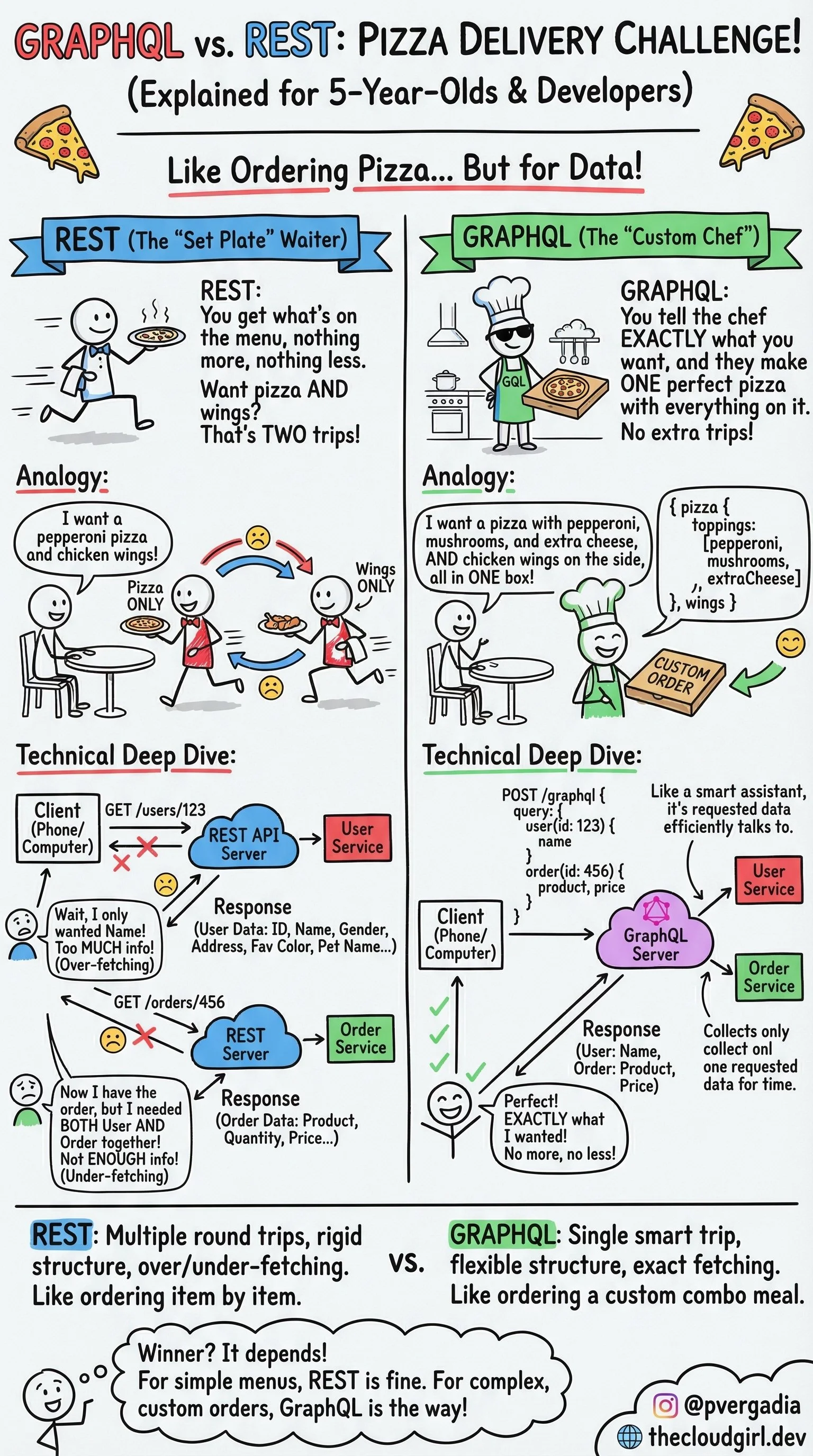
1. The REST-aurant: Resource-Oriented Rigidity
In the sketch, the REST side is depicted as a counter service where you must visit different stations to assemble your meal. In technical terms, REST is Resource-Oriented.
Every entity in your database (User, Post, Comment, Order) usually has its own URI (Uniform Resource Identifier).
The Latency Tax (Multiple Round Trips)
If you are building a dashboard that displays a User's name and their last 5 Orders, a pure REST implementation often requires a "waterfall" of requests:
1. `GET /users/123` (Wait for response... receive User ID)
2. `GET /users/123/orders` (Wait for response...)
In the analogy, this is the stick figure running from the Crust counter to the Sauce counter. On a high-speed fiber connection, this is negligible. On a spotty 3G mobile network, each round trip (RTT) adds significant latency. The user stares at a loading spinner because the network protocol forces sequential fetching.
The "Olives" Problem (Over-fetching)
Look at the pizza box in the REST section labeled "Over-fetching." The customer didn't want olives, but the restaurant includes them in every box.
In REST, the server defines the response structure. If the `/orders` endpoint returns the order ID, date, price, shipping address, billing address, and tracking info, but your mobile view only needs the price, you are downloading kilobytes of useless data. This "data waste" drains battery life and clogs bandwidth.
2. The GraphQL Kiosk: Client-Driven Flexibility
GraphQL, developed by Facebook, was designed specifically to solve the mobile data fetching issues described above. In the sketch, it is represented as a "Smart Kiosk."
One Endpoint to Rule Them All
Instead of thousands of endpoints (`/users`, `/products`, `/orders`), GraphQL exposes a single endpoint, usually `POST /graphql`.
The Query Language
The client sends a string describing the data shape it needs:
```graphql
query {
user(id: 123) {
name
orders {
product
price
}
}
}
```
This solves the Under-fetching problem. You don't "forget the cheese" because you can traverse the graph (User -> Orders -> Product) in a single request. The server parses this query and returns a JSON payload that mirrors the query structure exactly.
The Chef (Resolvers)
On the right side of the sketchnote, you see a "GraphQL Chef" picking ingredients from shelves. This represents the **Resolver** functions in your backend code.
While REST maps a URL to a controller, GraphQL maps a field to a function.
* The `user` field resolver hits the Users Database.
* The `orders` field resolver might hit a completely different Microservice.
To the client, it looks like a single unified data source. Behind the scenes, the "Chef" is orchestrating a complex gathering of ingredients.
3. If GraphQL is so efficient, why do we still use REST?
1. Caching Complexity: HTTP caching is built into the fabric of the web. In REST, a browser or CDN can easily cache `GET /crust`. In GraphQL, everything is a `POST` request, which is not cacheable by default. You have to implement complex client-side caching (using tools like Apollo or Relay).
2. The Complexity Shift: GraphQL simplifies the client code but complicates the server code. You have to manage schema definitions, type safety, and potential performance bombs (like highly nested queries that can crash your database).
Conclusion
Think of REST as a set of pre-packaged meal boxes. They are easy to distribute, standardized, and great if you like exactly what's in the box. Think of GraphQL as a personal chef. It requires more setup and communication, but you get exactly the meal you want, hot and fresh, in one sitting.
Choose the architecture that fits your users best.