Software 3.0: Intent Over Syntax
My job is to guide the Fortune 100 CTOs on redefining their AI-powered Software Development Life Cycle (SDLC), and I can tell you this: the transformation is never just about the coding. It is fundamentally about the humans—the developers evolving into architects, the designers prompting prototypes into existence, and the project managers shifting from timeline guardians to outcome owners. It is about re-engineering your entire process, evolving your talent stack, and rigorously defining business outcomes in a world of infinite leverage.
But amidst the strategy, one thing is palpable in every boardroom I enter, and that is the fear. It is the fear that in our rush to embrace "vibe coding" and autonomous agents, we are trading structural integrity for speed—building "black box" systems that work perfectly today, but that no human on the team truly understands how to fix tomorrow. When I sit in these boardrooms, the question isn't "Can AI write this code?" We know it can. The question is, "Who owns the outcome when the AI gets it wrong?"
We are witnessing a tectonic shift from Craftsmanship to Outcomes. We are entering the era of Software 3.0, and if you look at the sketchnote I created to map this territory, you'll see why this is the most disruptive moment in software engineering history.
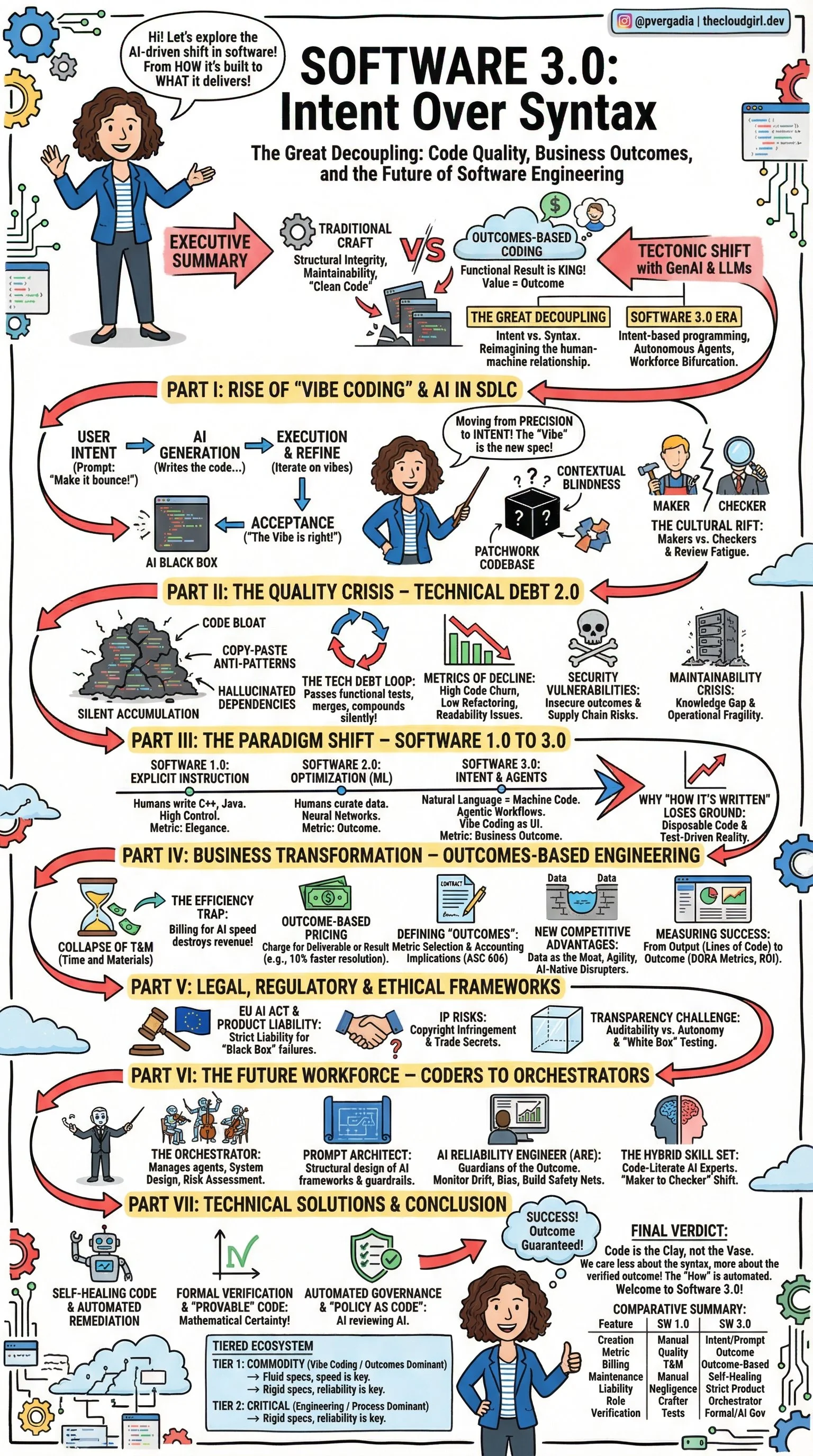
Software 3.0 Intent over Syntax
The "Vibe Coding" Shift: When Syntax Becomes Optional
Here is the reality check I give my clients: We are moving from explicit instruction to Intent Architecture.
Software 1.0 was about humans writing explicit logic (C++, Python). We cared deeply about the syntax.
Software 2.0 was about optimization (Machine Learning), where we curated data to train opaque neural networks.
Software 3.0 is about Generative Agency.
Andrej Karpathy calls the current behavior "Vibe Coding." It’s a fascinating, terrifying cultural shift where developers "give in to the vibes." They prompt the AI, execute the code, and if it works, they accept it. They don't read the diffs. They don't check the syntax.
For a junior developer or a startup prototyping a weekend project, this is magic. But for a Fortune 100 bank? It’s an existential risk. We are decoupling the creation of software from the understanding of software.
The Silent Debt of "Black Box" Velocity
The biggest lie in the industry right now is that "faster coding equals better business." The data tells a different story.
While we are seeing massive spikes in velocity, we are seeing a parallel spike in Code Churn—code that is written and then deleted days later because it wasn't right. We are seeing a 9% increase in bug rates correlating with high AI adoption in some studies.
This is Technical Debt 2.0. It’s not the kind of debt you knowingly take on to meet a deadline. It’s "Black Box Debt." It’s code that works, but nobody knows why. It’s filled with hallucinated dependencies and "copy-paste" patterns that bloat your infrastructure.
The human toll here is real. I see developers burning out not from writing code, but from "Review Fatigue." They are shifting from Makers to Checkers, tasked with auditing thousands of lines of machine-generated logic. It’s mentally exhausting, and eventually, they just start clicking "Accept."
The Business Pivot: RIP Time & Materials
This shift is breaking the economic backbone of the software services industry. For decades, we operated on Time and Materials (T&M). You paid for hours.
But in a Software 3.0 world, hours are irrelevant. If I can generate a microservice in 10 minutes that used to take 10 hours, the T&M model collapses.
We are moving to Outcome-Based Pricing. Look at Intercom’s Fin. They don’t charge you for the AI software; they charge you $0.99 per successful resolution. If the AI hallucinates, you don’t pay. This is the future. You are paying for the value delivered, not the code written.
From Coders to Orchestrators
This brings us back to the talent. What happens to the humans?
I tell CTOs: Do not fire your juniors. Evolve them. The role of the "Coder" is splitting into two new, high-value archetypes:
The Prompt Architect: This isn't just about writing clever text prompts. This is about System Design. These are the humans designing the "harness" that the AI lives in—the RAG pipelines, the context windows, the guardrails. They are the architects of intent.
The AI Reliability Engineer (ARE): This is the most critical role of 2026. While the "Vibe Coders" are generating features, the ARE is building the safety net. They monitor for Model Drift, bias, and hallucinations. They don't test the code; they verify the outcome.
Code is the Clay
We are heading toward a tiered future.
Tier 1 (Commodity): Internal tools, prototypes, marketing sites. Here, "Vibe Coding" wins. We won't care about the code, only the outcome.
Tier 2 (Critical): Banking cores, medical devices, flight systems. Here, the "How" matters more than ever. We will use Formal Verification and strict human oversight to ensure that the "Black Box" doesn't kill us.
My final advice to leaders is this: Code is the Clay, not the Vase. In the past, we obsessed over the fingerprints on the clay. In the future, we only care if the vase holds water. But it takes a human hand to ensure that vase is solid enough to stand the test of time.
Don't let the fear paralyze you. Let it drive you to build better governance, better talent, and better outcomes.