Month: October 2025

Uncategorized

How to Red-Team Your AI for Prompt Injection and Data Leakage

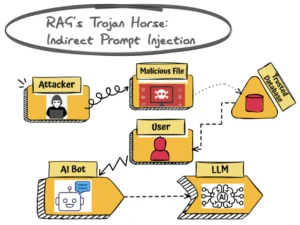
Your customer-support bot looked secure — until a user typed a jailbreak. This guide shows how the modern attack surface for LLMs (large language models / LLM) is the final assembled prompt used by RAG (retrieval-augmented generation) systems:Final Prompt = System Prompt + Retrieved Data + User Input. Attackers weaponize user input or retrieved documents to perform prompt injection, indirect prompt injection, and data exfiltration / data leakage.The threats (what red-teams do) Direct prompt injection (jailbreak) — attacker tells the model to “ignore previous instructions” and the model follows because tokens are tokens. Example: user forces the bot to become a comedian and leak info. Indirect prompt injection (Trojan horse via RAG) — malicious instructions are hidden inside uploaded docs (resumes, PDFs). When retrieved as context, the model obeys those instructions, bypassing user-input filters. This is the biggest RAG attack vector. Data exfiltration / The Heist — attacker social-engineers the LLM into dumping sensitive context or the system prompt (confidential internal commands, heuristics, DB schemas).Layered defenses (blue-team playbook) Input & output filtering — regex / keyword scanning for phrases like “ignore” or for leakage of the system prompt (useful but brittle). Robust prompt engineering (instructional fences) — separate instructions from data with strong delimiters (e.g., <system_prompt>, <retrieved_documents>, <user_query>). This tells the model which text is data vs instructions.Model-level defenses — prefer instruction-tuned models (GPT-4, Claude 3, Llama 3) and classification pipelines (cheap LLM for intent classification, strong LLM for answers). Use separate LLMs for safety checks. Automation for red-teaming — use tools like garak (open-source LLM vulnerability scanner) to run prompt injection probes and find weaknesses automatically. Follow standards — adopt the OWASP Top 10 for LLMs (LLM01: Prompt Injection, LLM02: Sensitive Information Disclosure, LLM08: Vectors & Embeddings, etc.) as part of secure development lifecycle.Takeaway / CTALLM security is a cat-and-mouse game. To protect against prompt injection, data leakage, and RAG-based Trojans, design defense-in-depth: input/output filters, strong prompt engineering, model-level controls, automated red-teaming (garak), and adherence to the OWASP Top 10 for LLMs. Red-team your models now — find the holes before someone else does.

Read more »

Uncategorized

Cheatsheet for Production-Ready Advanced RAG

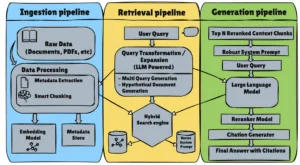
Cheatsheet for Production-Ready Advanced RAGOct 9Written By Akhil MohanYou built it. The demo was a hit. Your Retrieval-Augmented Generation (RAG) app flawlessly answered questions, pulling information from a mountain of documents. But then, it met real users.Now, it’s giving vague answers. It’s confidently making things up (hallucinating). Sometimes, it misses information that you know is in the source data. That impressive demo has turned into a brittle prototype, and you're left wondering: "Why is this so hard in production?"Sound familiar? You're not alone. While basic RAG is easy to prototype, building a robust, trustworthy system requires moving beyond the basics. This is the playbook for doing just that. We'll dissect the entire pipeline, using the architecture below as our map, to transform your fragile prototype into a production-grade asset.The Core Principle: Garbage In, Gospel OutAn LLM in a RAG system is a powerful reasoning engine, but it's fundamentally limited by the context it's given. If you feed it irrelevant, poorly structured, or confusing information, you'll get garbage answers. The secret to a great RAG system isn't just a better LLM—it's a superior retrieval process.Our journey to production-readiness focuses on systematically upgrading the three core stages you see in the diagram:The Ingestion Pipeline: How we prepare and index our knowledge base.The Retrieval Pipeline: How we find the most relevant information for a given query.The Generation Pipeline: How we synthesize that information into a trustworthy answer.Stage 1: Ingestion—Beyond Naive ChunkingThe foundation of any great RAG system is laid before a single query is ever asked. It starts with how you process your data.Technique 1: Stop Using Naive ChunkingSimply splitting your documents into fixed 1000-character chunks is fast, but it’s a primary source of retrieval errors. This method often splits sentences mid-thought, separating a cause from its effect or a question from its answer.The Solution: Smart ChunkingRecursive Character Splitting: A step up. This method splits text based on a hierarchical list of separators (like \n\n, \n, ) and tries to keep related paragraphs and sentences together. It's the go-to choice for a better baseline.Semantic Chunking: The advanced approach. Instead of using character counts, this technique uses an embedding model to split the text at points where the semantic meaning shifts. This ensures that each chunk is as contextually coherent as possible. While computationally heavier during ingestion, it pays massive dividends in retrieval quality.Technique 2: Enrich Chunks with MetadataIn a basic system, every chunk is just a piece of text. In an advanced system, every chunk is a rich object with context. During ingestion, extract and attach valuable metadata to each chunk.The Solution: Metadata Filtering Imagine your documents are technical manuals. For each chunk, store metadata like:source_file: "Q3_Security_Protocol.pdf"version: "2.1"chapter: "4"author: "Karl"Now, when a user asks, "What's the latest security protocol?", you can apply a pre-retrieval filter to only search within chunks where source_file contains "Security_Protocol" and version is "2.1". This drastically reduces the search space, leading to faster, more accurate, and less noisy retrieval.Stage 2: The Retrieval Overhaul—Finding the Right NeedleThis is where the magic happens. A user's query is often imprecise. Our job is to bridge the gap between what they ask and what our documents contain.Technique 1: Query TransformationInstead of taking the user's query at face value, we use an LLM to refine it first.Hypothetical Document Embeddings (HyDE): This is a clever technique where you first ask an LLM to generate a hypothetical answer to the user's query. This generated answer, while potentially factually incorrect, is rich in the language and keywords that a real answer would likely contain. You then embed this hypothetical answer and use it for the vector search. It’s like asking a detective to imagine a solution to a crime to figure out what clues to look for.Multi-Query Generation: You can ask an LLM to re-write the user's query from multiple perspectives. For a query like "How can I improve RAG performance?", it might generate variants like "What are the best techniques for RAG optimization?" and "Methods for reducing RAG latency." Searching for all these variants retrieves a more diverse and comprehensive set of documents.Technique 2: Hybrid Search (The Best of Both Worlds)Vector search is great at understanding semantic meaning, but it can struggle with specific keywords, product IDs, or acronyms. For instance, it might not distinguish well between GCP-Project-ID-12345 and GCP-Project-ID-54321.The Solution: Combine Semantic and Keyword Search By blending traditional keyword search algorithms (like BM25) with dense vector search, you get the best of both worlds. BM25 excels at finding documents with the exact keywords, while vector search finds documents with related meanings. Most modern vector databases offer hybrid search capabilities out of the box.Technique 3: The Final Check—RerankingYour hybrid search might return 20 potentially relevant documents. Are they all equally good? Probably not. Sending all 20 to the LLM creates noise and costs more.The Solution: Add a Reranker Model A reranker is a lightweight but highly accurate model that takes the initial list of retrieved documents and the user's query and re-scores them for relevance. Unlike the initial search (which uses a bi-encoder), a reranker often uses a cross-encoder, which looks at the query and each document simultaneously, leading to a much more accurate relevance score.Fact: Implementing a good reranker can boost retrieval accuracy (metrics like nDCG or Hit Rate) by 5-15% in many benchmarks, which is often the difference between a good and a great answer. You retrieve more candidates initially (K=20) and then use the reranker to distill them down to the absolute best (N=3-5) to send to the LLM.Stage 3: The Final Polish—Crafting Trustworthy AnswersYou’ve done the hard work of finding the perfect context. The final step is to ensure the LLM uses it correctly.Technique 1: Masterful Prompt EngineeringDon't leave the LLM's behavior to chance. Your system prompt is a contract that dictates its rules of engagement.The Solution: A Robust System Prompt Move from a simple "Answer the question" to a detailed set of instructions.You are an expert Q&A assistant. Your goal is to provide accurate and concise answers based ONLY on the provided context documents.Rules:1.  Analyze the provided context documents thoroughly before answering.2.  Answer the user's question based solely on the information found in the context.3.  If the context does not contain the answer, you MUST state: "I do not have enough information to answer this question." Do not make up information.4.  For each piece of information you use, you must cite the source document.Technique 2: Citing Your SourcesTrust is paramount. Always empower your users to verify the AI's answers. By passing the metadata you collected during ingestion all the way to this final stage, you can instruct the LLM to cite its sources. This not only builds user trust but is also an invaluable tool for you to debug where the information is coming from.Putting It All Together: From Prototype to ProductionBy evolving your architecture from a simple sequence to the multi-stage pipeline shown in the diagram, you address the core weaknesses of basic RAG. You're no longer just hoping for the best; you're systematically ensuring quality at every step.But how do you prove it's better? You measure it. Start exploring evaluation frameworks like RAGAs or TruLens. They provide metrics to quantify the performance of your system, such as:Faithfulness: Is the answer grounded in the retrieved context? (Measures hallucination)Answer Relevancy: Does the answer actually address the user's query?Context Precision & Recall: Did you retrieve the right context in the first place?ConclusionMoving a RAG system from a cool demo to a reliable tool isn’t about one magic fix. It’s about a deliberate, engineering-focused approach. It's about smart chunking, rich metadata, query transformation, hybrid search, reranking, and disciplined prompting.By adopting this playbook, you can turn your unpredictable prototype into a robust and trustworthy Q&A system that truly delivers value.

Read more »

Cart

Your cart is empty.

Start Shopping