Month: December 2025

Uncategorized

What is GraphRAG: Cheatsheet

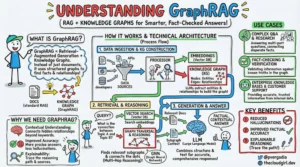
What is GraphRAG: CheatsheetDec 19 Written By Priyanka VergadiaUnpacking GraphRAG: Elevating LLM Accuracy and Explainability with Knowledge GraphsWe've all been there. You're building an intelligent agent, leveraging the power of Large Language Models (LLMs) for Q&A, content generation, or customer support. You've implemented Retrieval-Augmented Generation (RAG) – a solid architectural pattern that grounds your LLM in your own data, mitigating hallucinations and improving relevance. Yet, a persistent frustration remains: the LLM struggles with nuanced, multi-hop questions, fails to connect disparate facts, or sometimes, still confidently fabricates details when the answer isn't explicitly stated in a retrieved chunk. The black box problem persists, making it hard to trust the output.This is precisely the pain point that GraphRAG aims to solve, pushing the boundaries of what's possible with enterprise-grade LLM applications. It's not just an incremental improvement; it's a fundamental shift in how we augment LLMs, moving beyond flat document chunks to leverage the rich, interconnected world of knowledge graphs.Walkthrough of GraphRAGIf you look at the brilliant sketchnote above, it lays out the GraphRAG paradigm with remarkable clarity. Let's walk through its technical architecture step-by-step, much like we'd discuss a system design over coffee.What is GraphRAG? At its core, GraphRAG is Retrieval-Augmented Generation powered by Knowledge Graphs. While standard RAG fetches relevant documents or text chunks, GraphRAG specifically uses structured graphs to unearth facts and their intricate relationships. It's about moving from understanding individual sentences to comprehending the entire tapestry of information.How does GraphRAG Work?The process flow, as depicted under "HOW IT WORKS & TECHNICAL ARCHITECTURE," unfolds in three crucial stages: 1. Data Ingestion & KG ConstructionThis is where the magic of structuring your data begins.Data Sources: We start with diverse data – anything from unstructured documents (PDFs, internal wikis), structured databases, REST APIs, or even human input.The Processor: Here's a key component. This module takes all that raw, disparate data and orchestrates its transformation. It performs two critical tasks in parallel:Embeddings (Vector DB): Like standard RAG, chunks of your raw text are embedded into numerical vectors and stored in a Vector Database (e.g., Pinecone, Weaviate, Faiss). This enables semantic search later.Knowledge Graph (KG) Construction: This is the GraphRAG differentiator. The processor, often leveraging Large Language Models (LLMs) themselves for Information Extraction (IE), extracts entities (nodes) and their relationships (edges) from the raw data. Think of it as an automated Subject-Predicate-Object triple extractor. For instance, from "Priyanka built GraphRAG in 2023," it might extract (Priyanka, built, GraphRAG) and (GraphRAG, year, 2023). This structured data is then stored in a dedicated Graph Database (e.g., Neo4j, Amazon Neptune, ArangoDB). LLMs are incredibly adept at this task, especially when fine-tuned or carefully prompted for Named Entity Recognition (NER) and Relation Extraction (RE).2. Retrieval & ReasoningOnce your KG is built, the system is ready to answer complex queries:Query: A user asks a question, potentially one requiring deeper insight than a simple keyword match (e.g., "What is the connection between Topic A and Topic B?").Vector Search (Vector DB): Just like in standard RAG, an initial semantic search is performed against the vector database to retrieve relevant documents or text snippets that are semantically similar to the query. This provides immediate textual context.Graph Traversal & Reasoning: This is where GraphRAG truly shines. The query is also processed against the Knowledge Graph. Using Graph Neural Networks (GNNs) or traditional graph traversal algorithms (like BFS, DFS, shortest path), the system explores the graph to find relevant subgraphs, identify multi-hop relationships, and "connect the dots" that might be implicitly spread across multiple documents. A GNN can learn complex patterns and infer relationships that simple traversal might miss, providing a richer "subgraph context."3. Generation & AnswerThe final step brings everything together:LLM (Large Language Model): The LLM receives two powerful streams of context:Relevant Docs: The raw text snippets retrieved from the vector database.Subgraph Context: The structured, inferred relationships and facts from the knowledge graph.Synthesis: The LLM combines this structural and textual information. Instead of just paraphrasing retrieved text, it can now generate a more accurate, comprehensive, and factual contextual answer by weaving together direct textual evidence with the inferred relational insights from the graph. The outcome is a more reliable and insightful response.Under the Hood: GraphRAGImplementing GraphRAG involves several key architectural considerations:KG Schema Design: Crucial for success. A well-defined ontology (schema for nodes and relationships) is vital for consistent and effective extraction. This requires upfront data modeling expertise.IE Pipelines: LLMs for NER/RE are powerful but resource-intensive. For high-volume ingestion, a robust pipeline is needed, potentially involving specialized NLP models (e.g., spaCy) for initial extraction, followed by LLMs for more complex, context-dependent relationship identification, or using few-shot/zero-shot prompting.Graph Database Choice: Considerations include scalability (handling billions of nodes/edges), query performance for complex traversals, and integration with GNN frameworks (e.g., PyTorch Geometric, DGL). Neo4j's Cypher query language is popular for its expressiveness in graph traversal.Vector Database Integration: Efficient indexing (e.g., HNSW for approximate nearest neighbor search) and low-latency retrieval are paramount.GNNs for Reasoning: For truly advanced multi-hop reasoning, GNNs can learn embeddings of graph nodes and edges, enabling more sophisticated pattern matching and inference beyond simple pathfinding. Training and deploying GNNs adds complexity but can unlock deeper insights.Prompt Engineering: Combining disparate contexts (raw text vs. graph facts) effectively within the LLM's prompt is an art. Strategies include explicit formatting of graph triples or subgraphs in the prompt to guide the LLM's reasoning.Scalability & Latency: KG construction is often a batch process; keeping it updated requires robust data pipelines (e.g., Apache Kafka for event streaming, Spark for batch processing). Real-time inference needs optimized graph queries and GNN inference.When and Why to Choose GraphRAGGraphRAG isn't a silver bullet for every LLM use case. It introduces complexity and operational overhead, but the benefits for specific scenarios are transformative. When to Use GraphRAG:High Demand for Factual Accuracy & Explainability: When reducing LLM hallucinations and providing verifiable sources is non-negotiable (e.g., legal discovery, medical diagnosis support, financial reporting). The graph provides an auditable trail of facts.Complex Domains Requiring Multi-Hop Reasoning: When answers depend on connecting facts that aren't adjacent in source documents (e.g., "What is the causal link between X and Y based on our research papers?").Data with Inherent Relational Structure: If your data naturally has entities and relationships (e.g., supply chains, organizational charts, knowledge bases), GraphRAG leverages this structure optimally.Enterprise Knowledge Bases: For organizations seeking a single source of truth from internal documents, GraphRAG can power highly accurate and trusted information retrieval for customer support, internal tools, and research.When NOT to Use GraphRAG:Simple Q&A Tasks: For straightforward information retrieval where keyword or vector search in raw documents is sufficient, the overhead of KG construction and maintenance is unwarranted.Small Datasets: If your corpus is small and lacks complex interconnections, the benefits of a KG might not justify the effort.Highly Dynamic Data with Low Ingestion Latency Tolerance: KG construction and updates can be time-consuming. If your data changes minute-by-minute and real-time reflection in the KG is critical, the pipeline needs significant engineering.Limited Budget: Graph databases, GNN infrastructure, and LLM API calls for extraction can increase operational costs.Alternatives:Standard RAG: Simpler, faster to implement, and often sufficient for many use cases.Fine-tuning LLMs: Can improve domain-specific performance but is costly, less adaptable to new data without retraining, and doesn't inherently solve the hallucination or explainability problem as well as grounding in a verifiable graph.Hybrid Search: Combining keyword and vector search offers improved retrieval but lacks the explicit relational reasoning capabilities of a graph.GraphRAG represents a powerful evolution in augmenting LLMs. By explicitly modeling relationships, we empower LLMs to reason, verify, and explain their answers, moving us closer to truly intelligent and trustworthy AI systems.Priyanka Vergadiahttps://thecloudgirl.dev

Read more »

Uncategorized

The Life of an AI Query: Inside ChatGPT, Gemini, & Claude

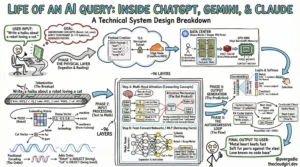
Here is a structured, deep-dive blog post based on the system design breakdown.Inside the Black Box: The Life of an AI Query through ChatGPT, Gemini, & ClaudeWhen you type a prompt into ChatGPT, Gemini, or Claude, the response feels instantaneous. It feels like magic. But behind that blinking cursor lies a massive symphony of distributed systems, high-bandwidth memory, and high-dimensional mathematics.For developers and engineers, "How does it work?" isn't just a curiosity—it is a system design question.In this post, we will trace the millisecond-by-millisecond journey of a single request, from the moment you hit "Enter" to the final generated token. We will use a specific prompt to illustrate how the model reasons:User Prompt: "Write a haiku about a robot loving a cat."Phase 1: The Physical Layer (Ingestion & Routing)The TravelBefore the math begins, the logistics must be handled. When you submit your prompt, it is wrapped in a JSON payload along with metadata (your user ID, session history, and temperature settings).The Handshake: Your request travels via TLS encryption, hitting an edge node (like Cloudflare) before routing to the nearest inference cluster (e.g., an Azure block for OpenAI or a TPU Pod for Google).Orchestration: A load balancer directs your query to a specific GPU/TPU with available compute slots.VRAM Loading: The model is too large to load on the fly. The weights (hundreds of gigabytes) are permanently resident in the GPU's High Bandwidth Memory (HBM). Your specific prompt and chat history are loaded into the active memory stack.Phase 2: Input Processing (Text to Math)The TranslationThe GPU cannot understand the string "Robot." It only understands numbers.1. Tokenization (The Breakup)The raw text is sliced into sub-word units called tokens.Input: ["Write", " a", " haiku", " ...", " robot", " loving", " a", " cat"]IDs: [8321, 10, 4521, ..., 19202, 8821, 10, 3921]Note that the concept of a "Robot" has been converted into the integer 19202.2. Embedding (The Meaning)The integer 19202 is used to look up a specific address in the model's Embedding Matrix. It retrieves a dense vector—a list of thousands of floating-point numbers.The Robot Vector: Contains mathematical values that align it with concepts like "metal," "machine," and "technology," but also "sentience" (derived from training data).The Cat Vector: Aligns with "biological," "fur," and "pet."3. Positional Encoding (The Order)Transformers process all words simultaneously (in parallel). Without help, the model wouldn't know if the Robot loves the Cat or the Cat loves the Robot.The Fix: A sinusoidal wave pattern (Positional Encoding) is added to the vectors. This stamps the "Robot" vector with the mathematical signature of being the subject (Position 6) and the "Cat" as the object (Position 9).Phase 3: The Transformer Block (The Reasoning Engine)The Deep DiveThe signal now travels through roughly 96 stacked layers of the Transformer. In each layer, the vectors are refined through two distinct mechanisms.Step A: Multi-Head Self-Attention (The Context Engine)This is the heart of the Transformer. The model asks: "How do these words relate to each other?"It does this using three learned matrices: Query (Q), Key (K), and Value (V).The Interaction:The "Robot" token generates a Query: "I am a machine. Are there any living things nearby?"The "Cat" token generates a Key: "I am a living thing. I have fur."The "Haiku" token generates a Key: "I impose a 5-7-5 syllable constraint."The Attention Score:The model calculates the Dot Product of the Robot's Query and the Cat's Key.Result: A high score. The model now "pays attention" to the relationship between the machine and the animal.Simultaneously, the "Haiku" token lights up, signaling that brevity is required.Step B: The MLP (The Knowledge Bank)After Attention, the data passes through a Feed-Forward Network (Multi-Layer Perceptron). This is where facts are retrieved.Activation: The vector is projected into higher dimensions. Specific neurons fire.The Retrieval: Neurons associated with "counting syllables" activate. Neurons linking "Robots" to "Steel" and "Cats" to "Purring" activate.Synthesis: The vector for "Robot" is updated. It is no longer just "19202"; it is now a rich data point representing "A metal entity feeling affection for a feline, constrained by a poetic format."Phase 4: Output Generation (The Prediction)After passing through all layers, the model arrives at the final vector. It is now time to speak.Unembedding: The final vector is projected against the model's entire vocabulary (50,000+ words).The Softmax: The model assigns a probability percentage to every possible next word."Metal": 12% (Fits the robot theme, 2 syllables)."Soft": 3% (Fits the cat theme, but ignores the subject)."Construct": 0.1% (Too technical/cold).The Selection: Using a decoding strategy (like Temperature), the model samples the winner: "Metal".Phase 5: The Autoregressive Loop (The Flow)The GrindThe model has generated one word. Now the cycle repeats, but with an optimization crucial for system performance.KV Cache: Instead of recalculating the math for "Write a haiku about a robot...", the model retrieves the calculated Key and Value vectors from the GPU's KV Cache.The Next Step: It only computes the math for the new token: Metal.Context Check: It looks at "Cat" and "Haiku".Constraint: We have 2 syllables (Met-al). We need 3 more to finish the first line (5 total).Prediction: heart (1 syllable).The Stream: This loop runs until the standard 5-7-5 structure is complete and an <EOS> (End of Sequence) token is produced.The Final OutputMetal heart beats fastSoft fur purrs against the steelLove knows no code baseSummaryWhat looks like a simple text response is actually a massive pipeline of data.Ingestion: Getting the data to the GPU.Tokenization: Converting language to integers.Attention: Understanding context and relationships ( Q×KQ \times KQ×K ).MLP: Retrieving factual knowledge.Autoregression: Predicting the future, one token at a time.Every time you see that cursor blink, you are witnessing a traversal through high-dimensional space, constrained by the speed of light in fiber optic cables and the memory bandwidth of silicon.

Read more »

Uncategorized

How is Agentic AI redefining Org Charts

How is Agentic AI redefining Org ChartsDec 15 Written By Priyanka VergadiaOrganization structures and org charts are going through a massive change with AI. Have you ever imagined an orchestra where the conductor doesn't just wave a baton, but actively plays every single instrument? Sounds chaotic and exhausting, right? That's precisely what many organizations feel like today: brilliant human talent bogged down playing every "instrument" in the business.But what if the conductor could orchestrate a symphony of highly skilled, autonomous instruments that play their parts flawlessly, while the human conductor focuses on the grand vision, the subtle nuances, and guiding the overall masterpiece? That, my friends, is the 'Aha!' moment of Agentic AI and the future of our organizational charts.In the cloud and tech world, we’re constantly chasing scalability, efficiency, and agility. Agentic AI isn't just another buzzword; it's the architectural blueprint for achieving these goals by moving from managing individual components to orchestrating entire intelligent ecosystems. It frees up our invaluable human capital for what they do best: strategic thinking, creativity, problem-solving, and empathetic human interaction.Let's dive into this brilliant sketchnote, "Agentic AI: Leaders Guide to Org Chart and Org Structure Evolution," to see how this paradigm shift unfolds:1. The Great Paradigm Shift: From Hierarchies to NetworksAs the diagram's "WHAT & WHY" section vividly illustrates, we're transitioning from a "Past: Human-Centric" model – characterized by silos, hierarchies, and linear growth where "Humans do ALL work" – to a "Future: Human + AI Agents" network. This isn't just about adding AI; it’s about a fundamental restructuring. The "Why" is clear: unlock exponential value, boost productivity, accelerate speed, and crucially, decouple cost from growth. Imagine a cloud environment where provisioning, scaling, and even incident response are largely managed by collaborating AI agents, leaving engineers to design new features and optimize global architecture.2. The New Org Chart in Action: Orchestration is KeyThe "ORG CHART EVOLUTION" section is where the rubber meets the road. Gone is the rigid CEO-Manager-Worker pyramid. In its place, we see "Outcome-Aligned Agentic Teams" where human and AI Agent Squads (both virtual and physical) collaborate cross-functionally, powered by efficient "Data Flow." Humans now operate "ABOVE THE LOOP" – steering, overseeing, and validating – while AI Agents are "IN THE LOOP," executing end-to-end tasks, 24/7. This means your operational teams become orchestrators, guiding intelligent systems to handle routine, repetitive, and even complex automatable tasks. Think about intelligent bots managing your CI/CD pipelines, optimizing resource allocation, or even triaging support tickets autonomously.3. Leadership & Architecture for an AI-First WorldThe "LEADERSHIP GUIDE" stresses vital "Mindset Shifts," moving from linear to "Exponential (Think Boldly!)" and seeing "Threat" as an "Opportunity." Critically, it outlines "New Talent Profiles" – from "M-Shaped Supervisors" who orchestrate vast systems to "T-Shaped Experts" who specialize deeply while safeguarding AI. The "AI-FIRST WORKFLOW & ARCHITECTURE" block highlights the technical backbone: an "Agentic AI Mesh" built on shared data, "Agent-to-Agent Protocols," dynamic sourcing, and "Embedded Guardrails (Governance)." This means designing systems that allow AI agents to communicate, coordinate, and even learn from each other autonomously, all while adhering to defined ethical and operational boundaries.Pro Tip: Build for Collaboration, Not Just ExecutionDon't just think about building individual AI models; start thinking about how your AI components can autonomously interact and collaborate. Design clear "agent-to-agent protocols" and robust APIs that enable seamless communication. Focus on building systems with embedded governance and self-healing capabilities, recognizing that your AI will be part of a larger, orchestrated symphony.The future of work, especially in tech, isn't just about AI doing tasks, but about humans and AI collaborating at an entirely new level.What are you seeing in your organizations?

Read more »

Uncategorized

Get a “Yes” every-time: A Guide to Cialdini’s 6 Principles of Persuasion

Have you ever wondered why you impulsively bought that "limited edition" gadget, or why you felt compelled to donate to a charity after signing a simple petition? It wasn't magic—it was psychology.Decades ago, Dr. Robert Cialdini wrote the seminal book Influence: The Psychology of Persuasion. He identified six universal principles that guide human behavior and drive us toward saying "Yes."Whether you are a marketer, a developer building a user base, or just someone trying to convince your team to adopt a new tool, understanding these principles is a superpower. Let’s break down these six concepts using the visual guide above.1. Reciprocity (Give to Get)The Core Concept: Human beings are wired to hate owing debts. If you do something nice for someone, they feel a biological and social obligation to return the favor.How it works: It creates a sense of obligation. You give value first without immediately asking for a return.Real-World Examples:Marketing: Offering a free E-Book or whitepaper in exchange for an email sign-up.Tech Community: When developers contribute to open-source code, the community often feels compelled to support that developer's paid projects or offer help in return.2. Commitment & Consistency (Start Small)The Core Concept: We all want to look consistent. Once we make a choice or take a stand, we encounter personal and interpersonal pressure to behave consistently with that commitment.How it works: Start with a small ask (a micro-commitment). Once a user says "yes" to the small thing, they are much more likely to say "yes" to a bigger thing to stay aligned with their self-image.Real-World Examples:Activism: Getting someone to sign a petition (easy) often leads to them donating money later (harder).SaaS Growth: Getting a user to create a free account makes them mentally "commit" to your platform, making an upgrade to Premium much more likely than a cold sale.3. Social Proof (Follow the Crowd)The Core Concept: When we are uncertain, we look to others to determine correct behavior. We assume that if many people are doing something, it must be the right thing to do.How it works: It leverages "safety in numbers."Real-World Examples:E-Commerce: Seeing 5-star reviews or testimonials reduces purchase anxiety.App Stores: A badge stating "1M+ Downloads" or "Editor's Choice" signals to a new user that the app is trustworthy and popular.4. Liking (Connect & Relate)The Core Concept: It sounds obvious, but it is powerful: We prefer to say yes to requests from people we know and like.How it works: We like people who are similar to us, who pay us compliments, and who cooperate with us towards mutual goals. This builds rapport.Real-World Examples:Sales: Finding shared interests (like gaming or sports) creates an immediate bond.Customer Success: A friendly support agent who uses a human tone can turn an angry user into a happy, loyal customer simply through the power of relatability.5. Authority (Trust Experts)The Core Concept: We are trained from birth to follow the lead of credible, knowledgeable experts. We trust titles, uniforms, and certifications.How it works: Authority signals (like a "Dr." title or a "Verified" badge) act as a shortcut for decision-making.Real-World Examples:Professional Services: Displaying badges like "Certified Professional" or awards.Thought Leadership: We listen to the Keynote Speaker at a tech conference because the stage itself confers authority.6. Scarcity (Limited Time/Supply)The Core Concept: The Fear of Missing Out (FOMO). Opportunities seem more valuable to us when their availability is limited.How it works: We hate losing freedoms. When our ability to choose a specific item is threatened by limited stock or time, we desire it more.Real-World Examples:Retail: The classic "Only 2 left in stock!" notification.Product Launches: Offering "Limited-time Beta Access" makes getting into the software feel like an exclusive privilege rather than a standard sign-up.A Note on EthicsWhile these principles are incredibly effective, they should always be used with integrity. The goal isn't to manipulate people into doing things they don't want to do; it is to lower the friction for them to do things that are actually good for them (like buying your excellent product or reading your helpful content).Start noticing these principles in your daily life—once you see them, you can’t unsee them!

Read more »

Uncategorized

Supervised vs Unsupervised vs Reinforcement Learning

Hey there, fellow tech explorers!Ever felt like training an AI is a bit like teaching a puppy? Sometimes you give it explicit commands, sometimes you just let it figure things out, and other times it learns by getting a treat (or a scolding!). That, my friends, is essentially the heart of Supervised, Unsupervised, and Reinforcement Learning in a nutshell.### The 'Aha!' Moment: Teaching Our Robotic Pal, RustyImagine you're trying to teach a new robotic assistant, Rusty, how to sort mail.‍ ‍*Supervised Learning:** You show Rusty thousands of envelopes, each pre-labeled as 'Urgent', 'Standard', or 'Junk'. You say, "See this? It's 'Urgent'." Rusty learns by mimicking your labels, finding patterns in the images and text that distinguish each category. It's like learning from flashcards with answers on the back.‍ ‍*Unsupervised Learning:** You hand Rusty a giant, unlabeled pile of mail and say, "Okay, Rusty, group these however you think makes sense." Rusty might discover that some envelopes are all blue and from the same sender, or that others consistently contain bills. It finds inherent structures and clusters without any prior labels. No flashcards, just pattern discovery.‍ ‍*Reinforcement Learning:** You put Rusty in a mailroom simulation. When it sorts mail correctly into the 'Urgent' bin, it gets a digital "treat" (a positive reward). If it puts a bill in the 'Junk' bin, it gets a "buzz" (a negative penalty). Rusty learns through trial and error, adjusting its strategy to maximize those treats over time. It's like learning to ride a bike – falling down (penalty) teaches you what not to do.### Why It Matters: Real-World Cloud & Tech ScenariosThis isn't just theory for robots; these paradigms are the backbone of almost every intelligent system we interact with daily in the cloud:‍ ‍*Supervised Learning** powers spam filters, medical diagnostics from images, fraud detection, and predicting customer churn. If you've ever gotten a 'recommended for you' product based on past purchases, that's often supervised.‍ ‍*Unsupervised Learning** is critical for customer segmentation (grouping users with similar behaviors), anomaly detection in cybersecurity, recommendation engines (finding similar users or items), and data compression.‍ ‍*Reinforcement Learning** is behind game AI (think AlphaGo), self-driving cars, optimizing data center energy usage, and even training complex robotic movements.### The Breakdown: How They Work (and Why You'd Pick One)Think of it like choosing the right tool for your data, as if you're sketching out your AI's learning path:1. Supervised Learning: The 'Labeled Guide' Approach:‍ ‍‍ ‍*How:** You provide a dataset with both input features and corresponding correct output labels. The model learns a mapping from input to output.‍ ‍‍ ‍*Why:** Ideal when you have historical, labeled data and need to make predictions or classify new, unseen data based on those past examples. It's about generalization from known answers.2. Unsupervised Learning: The 'Pattern Explorer' Approach:‍ ‍‍ ‍*How:** You give the model raw, unlabeled data. It seeks to find inherent structure, relationships, or clusters within the data itself.‍ ‍‍ ‍*Why:** Perfect when you lack labels or want to discover hidden insights, reduce data complexity, or identify anomalies that don't fit existing patterns. It's about finding hidden truths.3. Reinforcement Learning: The 'Trial-and-Error Navigator' Approach:‍ ‍‍ ‍*How:** An "agent" interacts with an "environment," taking actions and receiving rewards or penalties, learning a "policy" to maximize cumulative rewards.‍ ‍‍ ‍*Why:** Best for dynamic environments where an agent needs to make sequential decisions and learn optimal behavior through direct interaction, often without a predefined dataset of "correct" actions. It's about learning through experience.### Pro Tip for Developers:Before you even think about algorithms, understand your data and your problem. Is your data labeled? Do you need to predict a specific outcome, or just understand underlying groupings? Does your system need to make decisions in a dynamic environment? Your data's nature and your project's goal will naturally steer you towards the right learning paradigm.Happy Sketching! - Priyanka

Read more »

Cart

Your cart is empty.

Start Shopping